Steak Doneness: What Each Level Actually Gets You
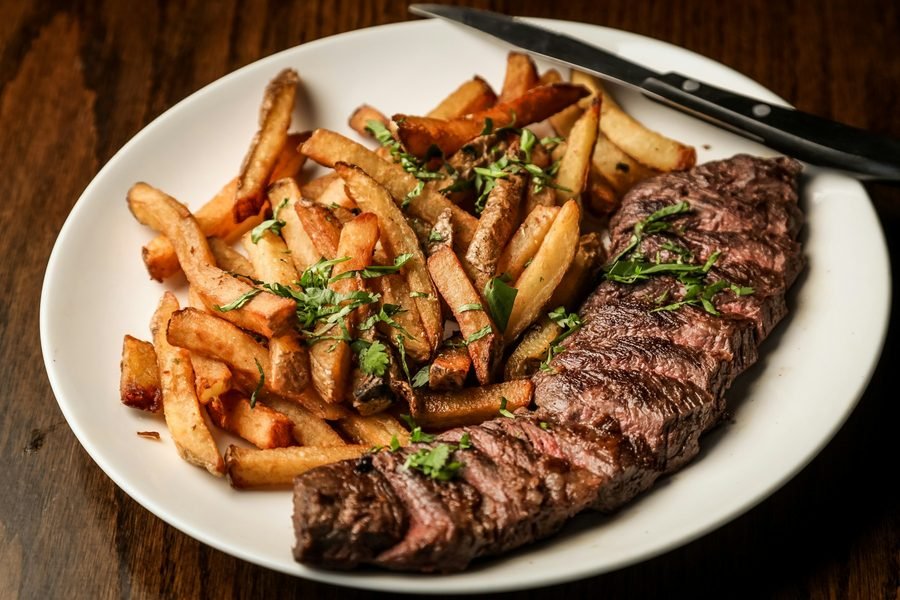
The menu lists five levels: rare with a cool red centre, medium rare warm red, medium hot pink, medium well slightly pink, and well done with no pink.
What the menu does not say is that the right choice depends heavily on which cut you ordered, because lean and fatty cuts behave completely differently as they cook.
What is happening inside the steak
As muscle fibres heat they contract and squeeze out moisture. That process is gradual up to about medium and accelerates sharply after it, which is why the step from medium to medium-well costs more juiciness than the step from rare to medium.
Fat behaves oppositely. It renders and lubricates as it heats, so a fatty cut gains something at higher temperatures while a lean cut only loses.
This single asymmetry explains almost every piece of steak advice worth knowing.
Matching doneness to cut
Sirloin is lean at roughly 42 calories per ounce. It has very little fat to compensate for lost moisture, so past medium it turns dry and firm. Medium rare is where it performs best.
Ribeye at roughly 80 calories per ounce has fat throughout. It stays palatable at medium-well and even well done, which makes it the honest choice for anyone who does not want pink.
Filet is the most tender and among the leanest. Cooking it past medium removes the texture that justified the $3.67 per ounce, which makes a well-done filet the single least efficient order on the menu.
Prime rib is largely pre-determined by the roast, so it offers the least control of any beef on the board.
- Sirloin — medium rare, and no further than medium
- Ribeye — anything up to well done survives
- Filet — medium rare or medium, never beyond
- Porterhouse — the filet side cooks faster than the strip side
- Prime rib — set by the roast rather than by your order
Practical notes
A thicker steak at the same weight cooks more evenly, because there is more distance between surface and centre. The 8oz Thick Cut New York Strip is the clearest example on this menu — it is the same weight as other 8oz options but shaped to hold a gradient better.
If a steak arrives underdone it can go back to the grill. If it arrives overdone, nothing can be done. Ordering one level below your target is the safer error.
The Smother Your Steak option at $2.29 adds mushrooms, onions, jack cheese or brown gravy and does genuinely help a steak that has gone slightly further than intended.
Frequently asked
What doneness do most people order?
Medium and medium rare account for the large majority in most steakhouses.
Is rare steak safe?
For whole-muscle cuts, yes — bacteria live on the surface, which the sear reaches. Ground beef is different, which is why Road Kill and the burgers are not offered rare.
Can I send a steak back?
If it is undercooked, yes, and it is reasonable to. An overcooked steak cannot be uncooked, so it is worth flagging quickly if the first cut looks wrong.
Keep reading
Sirloin vs Ribeye: Which to Order and Why
One extra ounce of meat, 500 extra calories, and $4 more. The comparison that explains the whole steak page.
Read →
The Best Steak at Texas Roadhouse, by Four Different Measures
"Best" depends entirely on what you are optimising for, and the four answers are four different steaks.
Read →
Prime Rib vs Ribeye: Same Muscle, Different Dish
Same muscle, two cooking methods, two genuinely different eating experiences — and one of them sells out.
Read →