Bone-In or Boneless: What the Bone Actually Does
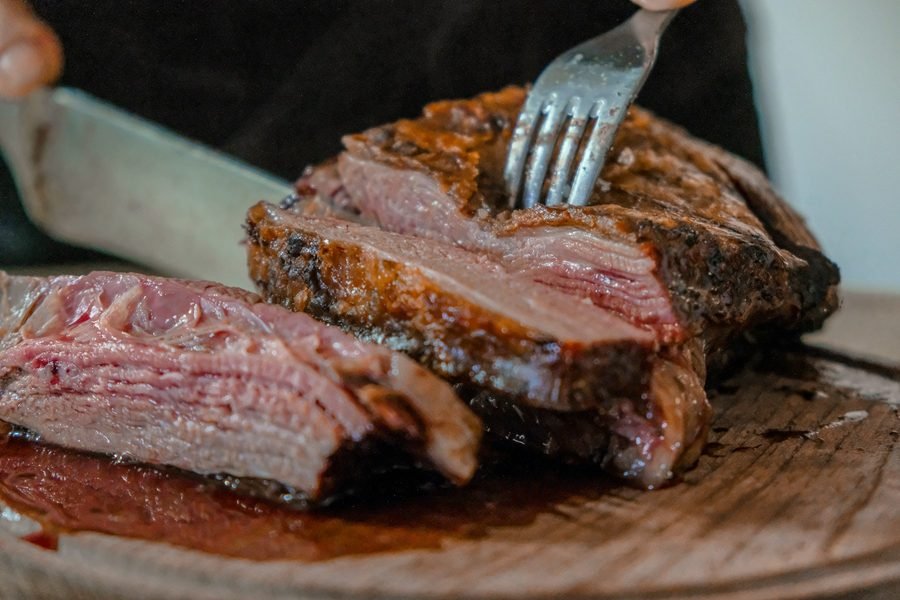
Two cuts on this menu include bone: the 20oz Bone-In Ribeye at $29.99 and the 23oz Porterhouse T-Bone at $33.99.
Both look like strong value on a per-ounce basis, and both figures carry an asterisk worth understanding.
What the bone genuinely contributes
Insulation. The bone shields the meat immediately against it, so that portion cooks more slowly and stays rarer. This produces more variation across a single steak, which many people specifically like.
Flavour at the interface. The meat closest to the bone is widely considered the best part of the steak, and there is a real basis for it — connective tissue and marrow contribute during cooking.
Presentation, which is not nothing. A bone-in ribeye is a more impressive plate than a boneless one of similar weight.
What it costs you
Weight you pay for and do not eat. A 20oz bone-in steak does not deliver 20oz of meat, and the stated per-ounce figures on this site are calculated on total weight because that is what the menu states.
On paper the Bone-In Ribeye at $1.50 per ounce and the Porterhouse at $1.48 look like the second and third best value on the steak page. Adjusting roughly for bone moves both toward the middle of the table.
They remain reasonable orders. The point is that the raw per-ounce figure flatters them against boneless cuts, and a comparison that ignores that is not being straight.
- Bone-In Ribeye — 20oz, $29.99, 1,480 cal
- Porterhouse T-Bone — 23oz, $33.99, 1,040 cal
- Both look strong per ounce — both include inedible weight
- Bone keeps the adjacent meat rarer
- Best boneless value — 16oz Sirloin at $1.44/oz
Which to choose
If you want maximum edible meat per dollar, boneless — specifically the 16oz Hand-Cut Sirloin at $1.44 per ounce, which has no adjustment to make.
If you want the fullest ribeye experience and are not counting ounces, the Bone-In at $29.99.
If you want two different cuts on one plate, the Porterhouse, which is the only item on the menu offering that and is comfortably shareable between two.
One practical note: the Porterhouse's filet side cooks faster than its strip side, so ordering it beyond medium overcooks the filet before the strip is ready.
Frequently asked
Is bone-in better?
It cooks less evenly, which some people prefer, and the meat near the bone is widely considered the best part. It is a taste preference rather than a value decision.
Do the per-ounce figures account for bone?
No — they use the stated menu weight. That is why bone-in cuts look better on that measure than they strictly are.
Which bone-in cut is better?
The Bone-In Ribeye for richness, the Porterhouse for variety since it gives you a strip and a filet.
Keep reading
The Porterhouse T-Bone: Two Steaks on One Bone
The biggest plate on the menu at 23oz, and the only one that puts two different cuts either side of a single bone.
Read →
The Ft. Worth Ribeye: Three Sizes and a Bone-In Option
The marbled cut most steakhouse regulars default to, in three boneless sizes plus a 20oz bone-in.
Read →
Every Steak Ranked by Price Per Ounce
The number no menu prints, computed for all sixteen steak sizes. It changes which steak looks like the good deal.
Read →